

The Role of AI in Modern Real Estate Agent Productivity
AI Is Not a Magic Button: It Is a Leverage Tool
Every few years a technology shift lands in real estate and agents split into two camps: early adopters who figure out the workflow and everyone else who waits to see what happens. AI is that shift right now. The agents treating it like a magic button are disappointed. The agents treating it like a leverage tool are reclaiming hours every week and putting that time back into dollar-productive activity.
This post breaks down the mechanism, the workflow, and the honest tradeoffs so you can make a clear decision about where AI belongs in your production system.
Where Time Actually Goes in a Real Estate Business
Before you can use AI to protect your time, you have to know where your time is going. Most agents, when they track their week honestly, find roughly the same pattern:
- Prospecting and follow-up: the activities that generate income
- Appointment preparation: research, CMAs, listing presentations
- Content creation: emails, social posts, newsletters, property descriptions
- Transaction coordination: checklists, vendor follow-up, document management
- Administrative drag: scheduling, status updates, repetitive communication
The first two categories are where your income lives. The last three are where your hours disappear. AI earns its place by compressing the last three so you can expand the first two. That is the whole framework. Everything else is detail.
The Four Workflow Areas Where AI Pays Off Most
1. Written Communication at Scale
Writing is one of the biggest time drains in a real estate business. Property descriptions, follow-up emails, just-listed and just-sold letters, neighborhood market updates, buyer and seller guides: each one takes longer than it should when you are starting from a blank page.
AI language models like ChatGPT or Claude let you start with a structured prompt instead of a blank page. You input the key facts, the tone, the audience, and the call-to-action, and you get a working draft in seconds. Your job shifts from writing to editing. That is a fundamentally different cognitive task and it is faster.
The workflow that works: create a master prompt library for your most repeated content types. A listing description prompt. A price reduction email prompt. A pre-listing package intro prompt. Spend thirty minutes building those once and they serve you for years.
2. Market Analysis Preparation
Pulling comps is not the slow part. Translating raw MLS data into a coherent story that a seller can actually understand: that is where time goes. AI tools can help you draft the narrative layer of a CMA, explain absorption rate in plain language, and frame pricing strategy in a way that builds seller confidence without oversimplifying.
You still own the judgment. The AI handles the explanation scaffolding. Together you produce a sharper presentation in less time.
3. Database and Follow-Up Consistency
Ninja Selling and Mike Ferry both point to the same truth: consistent follow-up with your database is the single highest-leverage activity in this business. Most agents know this and still let follow-up slip because writing a fresh, relevant touchpoint for each contact feels like a lot of work.
AI removes the blank-page problem from follow-up. You can generate a month of personalized email touchpoints in a single session by feeding your AI tool the contact context: buyer or seller, where they are in the process, what they care about, what market conditions are relevant to them right now. The result is a contact strategy that feels personal because the inputs were specific, even though the drafting was fast.
This is not spam. It is preparation. You still review, personalize, and approve every touchpoint before it goes out. The AI is your first-draft engine, not your replacement.
4. Training, Scripts, and Role-Play Preparation
This one surprises agents until they try it. AI is an effective tool for script practice. You can paste a Mike Ferry objection-handling script into a conversation and ask the AI to play the role of a resistant seller. It will give you pushback, ask follow-up questions, and help you find the gaps in your delivery before you are in front of a real client.
For team leaders and brokers, this opens up a scalable coaching layer. New agents can rehearse pricing conversations, listing presentations, and buyer consultations outside of scheduled training sessions. Repetitions go up. Confidence goes up. Ramp time goes down.
What AI Cannot Do: The Lines That Matter
Clarity here protects you from bad decisions. AI does not replace the following:
- Your local market knowledge and the judgment that comes from being in transactions daily
- Relationship trust built through real conversations over time
- Negotiation, which requires reading people in real-time
- Your accountability to fiduciary duty and fair housing compliance
- The prospecting calls themselves: the phone still has to ring, and you still have to be the one who picks it up
AI is an efficiency layer, not a relationship layer. Agents who conflate the two end up with polished content and thin pipelines. Keep prospecting at the center of your schedule and use AI to protect that time by making everything around it faster.
Building an AI Workflow That Actually Sticks
The reason most agents experiment with AI and then drift away from it is the same reason most people drift away from any new system: no structure. Here is a simple framework to make it stick.
- Start with one use case. Pick the task that costs you the most time and build your first AI workflow around that single task. Do not try to automate everything at once.
- Build a prompt library. Every time you create a prompt that produces a result you like, save it. Treat your prompt library the way you treat your scripts: as an asset that compounds over time.
- Set a weekly review habit. Block fifteen minutes every Friday to review what you used AI for that week, what worked, and what needs a better prompt. Small iterations compound fast.
- Protect your dollar-productive time first. AI earns its place by giving you more prospecting hours, not by filling the time you would have spent prospecting. If your schedule is not protecting prospecting time, fix that first.
The Agent Who Uses AI Well Looks Different
They are not the agent posting every hour on social media. They are the agent whose written communication is consistently sharp, whose database touchpoints actually get sent, whose listing presentations are clean and confident, and who still makes their prospecting calls every morning because they are not drowning in administrative drag.
That is what the right AI workflow produces: not a flashier feed, but a tighter, more consistent business with more time for the activities that actually generate income.
Ready to Build a More Productive Real Estate Business?
At Real Estate Easier, we work with agents, teams, and brokerages to build systems that actually hold up under production pressure. AI is one layer of that. Database structure, prospecting accountability, and lead conversion workflows are others. If you want to see how these pieces fit together in a business like yours, visit realestateeasier.com or call us directly at 617-675-5787. We work with real producers who want real results, not more noise.
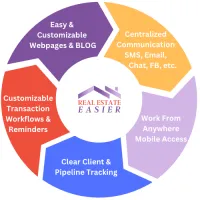
All Your Real Estate Tools And Systems In One Place


© 2026 Real Estate Easier LLC - All Rights Reserved.