

The Spreadsheet-to-CRM Transition That Breaks Every Top Producer
Most producing agents have a quiet moment where they admit it: "I've got most of it in a spreadsheet." They say it apologetically — because they already know it's the wrong answer. And the question they're really asking is: what should I be doing instead?
Why the spreadsheet works (until it doesn't)
Spreadsheets are great at the start. You're closing 12–15 deals a year. You know every lead by first name. The list of past clients fits on one screen. Birthdays, anniversaries, kids' names, last property sold — all sittings in columns A through P, color-coded by status. The system feels efficient because you are the system.
Then volume catches up. You hit the plateau. The 12–15-deal year that paid the bills now looks like the ceiling, not the floor. And you start to notice that the spreadsheet isn't telling you anything about the people inside it. It's just a list. It does nothing on its own. While you're showing properties on Saturday, the spreadsheet sits in iCloud doing zero outreach.
That's the moment when the spreadsheet shifts from being a tool to being a tax. Every hour you spend updating it is an hour you're not on the phone or in front of clients. And every birthday you forget, every anniversary that passes unnoticed, every "just checking in" touch you don't make — that's a referral your sphere is quietly handing to someone else.
What a real CRM actually does
The pitch most agents have heard is "you need a CRM." The pitch is incomplete. A CRM doesn't replace your spreadsheet. A spreadsheet is a list. A CRM is a system. A list sits there. A system acts.
What that means in practice:
- Automated follow-up — touchpoints fire on schedule whether you remember them or not. Birthdays, anniversaries, market updates, just-listed alerts to the right segments of your sphere. Your sphere stays warm 365 days a year, not just on the days you happen to think about them.
- Lead capture from your website that doesn't go cold — a form fill triggers an immediate response, then a sequence, then a notification to you when the lead becomes warm enough to call. The leads that used to die in your inbox at 11pm now stay in motion until you can take over.
- Pipeline visibility — every active buyer, every active seller, every nurture, every dormant past client showing renewed activity — all in one view. You see the next dollar coming, not just the next closing.
- Texts and emails from one place — no more switching between five apps and losing the thread on what you said to whom. Conversations live alongside the contact, the deal, and the history.
- Mobile-first execution — the work happens between showings, not at a desk. Real Estate Easier's mobile app means a lead alert turns into a tap-to-call within seconds, not after you get home.
Why most agents stall on the transition
The spreadsheet-to-CRM jump fails for a small number of repeating reasons:
- Generic CRMs that aren't built for real estate — Salesforce, HubSpot, generic SaaS. They look powerful on the demo, but configuring them for residential real estate workflows takes weeks or a consultant. Most agents quit after the first two evenings of trying to make them fit.
- Real estate CRMs that aren't customizable enough — the off-the-shelf real-estate-branded options often ship with rigid pipelines, fixed automation rules, and stage names that don't match how you actually work. You end up with a CRM you fight every day.
- No coaching support — the technology is half the battle. The other half is rebuilding habits — picking up the phone when the system pings you, trusting an automation to fire instead of doing it manually, treating the CRM as your single source of truth instead of running it in parallel with the spreadsheet.
The transition that actually works
Real Estate Easier was built specifically for this jump. Three things make the difference:
- Full customization — pipelines, stages, automations, fields, tags. Match the system to your business instead of bending your business to the system. Your buyers don't move through stages a software vendor invented; they move through the stages you defined.
- Customizable AI — your sphere doesn't want a generic chatbot answering them. Real Estate Easier's AI is configured to your voice, your market, your offerings — and it nurtures, qualifies, and surfaces the conversations that need you, before your day even starts.
- Coaching included — the technology gets installed; the habits get coached. Real Estate Easier pairs the platform with done-with-you coaching so the spreadsheet-to-CRM transition doesn't stall in the configuration weeds.
The agents who break through the $5–10M plateau aren't doing more activities. They're running a system that does the activities for them. The spreadsheet was a stepping stone. Past 15 deals a year, it becomes a ceiling.
If you're still in the spreadsheet
That's fine. You're not behind. You're at the same point every producing agent reaches. The decision worth making this quarter is whether to make the next twelve months an extension of the same approach — or whether to put a system in place that actually moves with you.
Real Estate Easier is built for that decision. Ready to see what the spreadsheet has been costing you? See it in action.
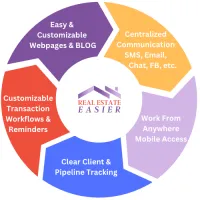
All Your Real Estate Tools And Systems In One Place


© 2026 Real Estate Easier LLC - All Rights Reserved.