

How AI Is Transforming Real Estate CRMs: What Agents and Teams Need to Know
The CRM Problem Most Agents Never Solve
Most agents have a CRM. Most agents do not actually use it. The database sits full of contacts with no follow-up plan, no priority logic, and no consistent touchpoints. That is not a discipline problem. It is a system problem, and AI is starting to fix it at the structural level.
This post breaks down exactly how AI is being embedded into real estate CRMs right now, what it actually does versus what vendors overpromise, and how agents, teams, and brokerages can use it to build a production machine instead of a digital rolodex.
What AI in a Real Estate CRM Actually Means
When a CRM vendor says "AI-powered," that phrase can mean a dozen different things. Here is how to read it clearly:
- Predictive lead scoring: The system analyzes behavioral signals (email opens, site visits, listing page time, text response patterns) and ranks contacts by estimated readiness to transact.
- Natural language generation: AI drafts follow-up emails, texts, or call scripts based on contact data and conversation history so agents start from something instead of nothing.
- Automated conversation routing: AI chatbots or SMS sequences handle first-touch responses and qualify leads before a human ever picks up the phone.
- Pattern recognition across pipelines: The system identifies which lead sources, price points, or follow-up sequences are producing the best conversion rates and flags them for the agent or team leader.
- Task and workflow automation: Based on contact behavior or stage changes, the CRM automatically triggers the next step: a task, a drip sequence, a notification to the agent.
None of these replace the relationship. All of them protect the relationship by making sure it does not fall through the cracks.
How Predictive Scoring Changes the Way You Work Your Database
In traditional CRM use, agents either work their database alphabetically, by gut feeling, or not at all. Predictive scoring changes the workflow at its foundation.
Instead of asking "who should I call today?", the system tells you. A contact who visited three listings in the past 48 hours, opened your last two emails, and clicked on a mortgage calculator link gets a high score. A contact who has been dormant for six months gets a low one. You call the high-score contacts first, every single day, without having to think about it.
This is exactly the kind of behavioral prioritization that Mike Ferry has coached agents toward for decades... the AI just does the sorting automatically. Your job shifts from identifying who to contact to executing the contact itself.
For teams running large databases, this is the difference between a lead falling silent and a lead converting. The system does not forget. It does not have a bad day. It surfaces the right name at the right time.
AI-Generated Follow-Up: Starting From Something
One of the biggest conversion killers in real estate is follow-up paralysis. Agents know they should reach out. They open a blank text box, do not know what to say, and close the tab. The lead waits. The lead goes elsewhere.
AI-generated draft messages solve the blank-page problem. The system pulls context from the contact record: what they have looked at, where they are in the buying or selling process, what their last interaction was, and it generates a first draft. The agent edits, personalizes, and sends.
This is not about outsourcing your voice to a robot. It is about removing the friction between intention and execution. In Ninja Selling terms, it supports the daily habit of putting people into your flow by making the physical act of reaching out faster and easier.
Teams benefit even more here because message quality and consistency are no longer dependent on which agent happens to be having a productive day.
Automated Conversation Routing: First Response Without Delay
Speed to lead is one of the most documented factors in real estate conversion. According to a study published by the Harvard Business Review, companies that contacted prospects within one hour were nearly seven times more likely to qualify the lead than those that waited even two hours.
For a solo agent or a team with overlapping appointments and client commitments, one-hour response windows are nearly impossible to maintain manually. AI-driven response automation changes the math.
When a new lead comes in through any source, the CRM can immediately send a personalized text or email, begin a qualifying sequence, and alert the agent only when the lead has responded or hit a threshold score. The lead experiences immediate engagement. The agent engages when they are actually available to have a real conversation.
This is not automation instead of relationships. It is automation that keeps the relationship alive until the agent can carry it forward.
Pipeline Intelligence: Seeing What Is Actually Working
One of the most underused features in modern AI-enhanced CRMs is pipeline analytics. Instead of just tracking where contacts are in a funnel, these systems identify patterns across your entire database:
- Which lead sources are producing closings versus just producing contacts
- Which follow-up sequences have the highest response rates at which stage
- How many touchpoints, on average, precede a listing appointment for your specific market
- Which price ranges or property types are moving through your pipeline fastest
For a team leader or broker, this data ends the guesswork around where to spend marketing dollars and where to focus coaching conversations. For a solo agent, it answers the question that most people never actually examine: what is my real conversion rate by source, and is my follow-up system doing the work?
Where AI Still Falls Short in Real Estate CRMs
Honest evaluation requires calling out the gaps:
- Data quality dependency: AI is only as good as the data you feed it. A CRM full of incomplete contact records, wrong phone numbers, or uncategorized lead sources will produce weak scoring and irrelevant suggestions. Garbage in, garbage out, regardless of how sophisticated the algorithm is.
- Tone and context blind spots: AI-generated messages still need human review. The system does not know that a particular contact is grieving a loss, going through a divorce, or had a bad experience with your brokerage. Context that lives outside the CRM fields does not exist for the AI.
- Adoption friction: The best AI features in any CRM only work if agents actually log their activity, update contact records, and use the system consistently. AI does not fix a culture where agents avoid their CRM. That is still a leadership and accountability problem.
- Overreliance risk: Automation can create false confidence. A lead in a sequence is not the same as a lead being worked. Agents still need to make calls, hold real conversations, and build actual relationships. The CRM is the infrastructure. The agent is the business.
How to Evaluate an AI-Enhanced CRM for Your Operation
Before you change platforms or add a tool, run these questions:
- Does the AI scoring model train on your own data over time, or does it use generic industry benchmarks?
- Can you see the logic behind a contact's score, or is it a black box?
- Does the system integrate with your lead sources so data flows in automatically, or does it require manual import?
- What does the workflow look like from the agent's perspective on a daily basis? Is there a clear "here is what to do today" interface?
- What training and onboarding does the vendor actually provide, and what does adoption look like for teams your size?
A CRM that looks impressive in a demo but requires three hours of setup per week to maintain is not a system. It is another source of friction disguised as a solution.
The Bigger Picture: AI as a Production System
The goal of integrating AI into your CRM is not to look cutting-edge. It is to build a database-driven production system where every contact is touched at the right time, with the right message, and the right next step is always clear.
That goal has been the foundation of high-production real estate for decades. Ninja Selling, Mike Ferry, Howard Brinton... every methodology that produces consistent closings is built on consistent, systematic contact. AI does not change that principle. It just gives you better tools to execute it at scale.
The agents and teams who will win with AI are not the ones who adopt every new feature. They are the ones who get clear on their workflow, feed the system clean data, and hold themselves accountable to the daily disciplines that no algorithm can replace.
Take the Next Step
If you want to go deeper on how to structure a CRM-driven production system for your real estate business, Real Estate Easier is built for exactly that kind of work. Visit realestateeasier.com to explore resources, tools, and support designed for agents and teams who are serious about building real systems. You can also reach out directly at 617-675-5787. No pitch, just a straight conversation about what is working and what your operation actually needs.
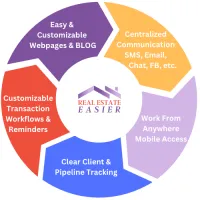
All Your Real Estate Tools And Systems In One Place


© 2026 Real Estate Easier LLC - All Rights Reserved.